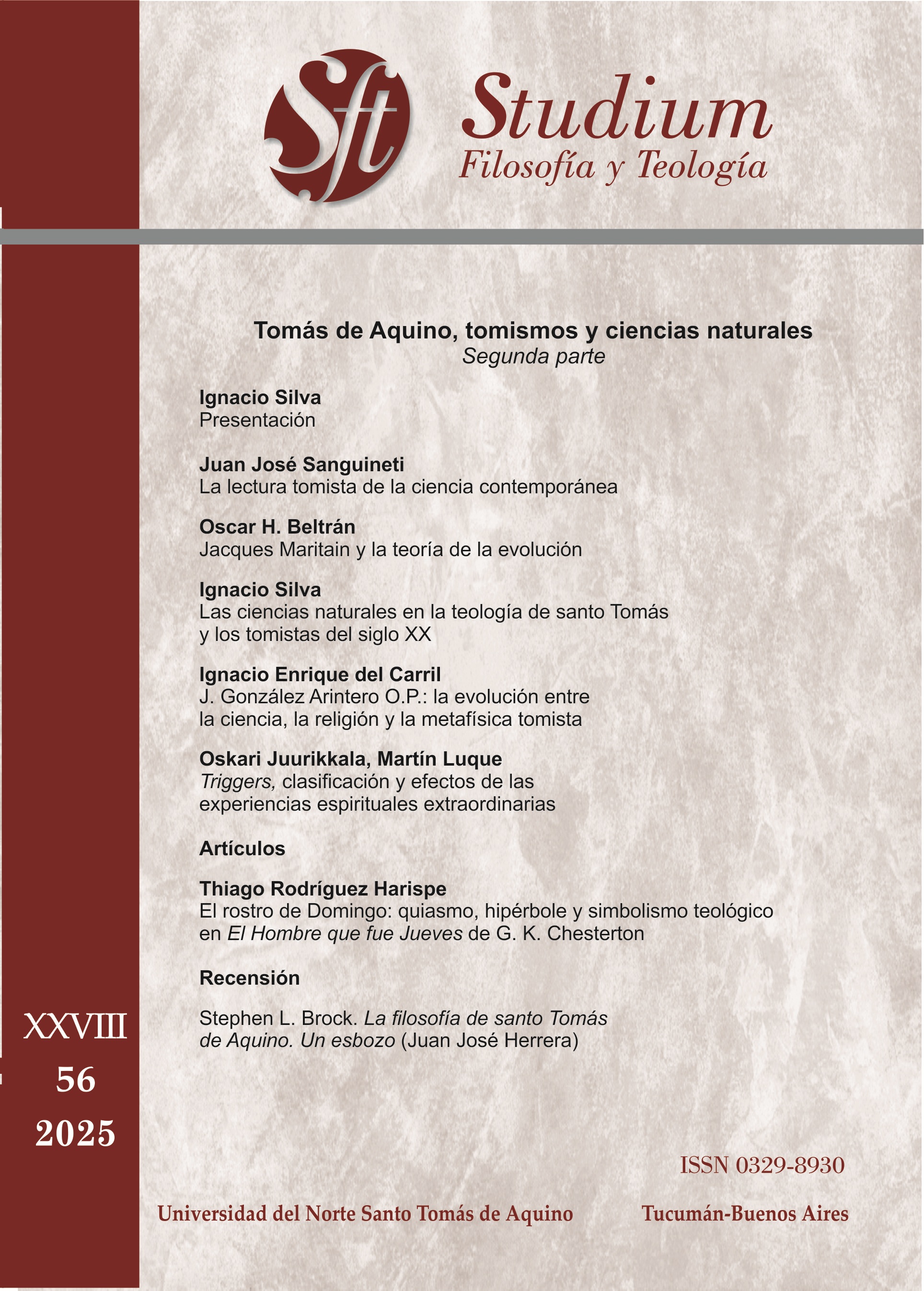
Sunday’s face: Chiasmus, Hyperbole and Theological Symbolism in The Man who was Thursday by G. K. Chesterton
DOI:
https://doi.org/10.53439/stdfyt56.28.2025.361-384Keywords:
G. K. Chesterton, The Man Who Was Thursday, theological symbolism, Sunday, God’s faceAbstract
This paper seeks to analyze the theological symbolism embodied in the face of Sunday, a character on The Man Who Was Thursday: A Nightmare by G. K. Chesterton, in relation to the human experience of the divine abyss. To this end, we employ the method of structural analogy proposed by Karl-Josef Kuschel, with the aim to conducting an interdisciplinary study between theological science and literary criticism. Our central hypothesis is that the novel expresses the experience of the theological abyss through a chiasmic and hyperbolic symbolism that structures the entire oneiric framework of meaning within the work.
Downloads
References
Agustín de Hipona. (1837). S. Aurelii Augustini Confessiones. C. Tauchnitii.
Alighieri, D. (2021). Divina Comedia. Vol. I: Infierno. Colihue.
Avenatti de Palumbo, C. I. (2012). Hablar de Dios desde la herida: el quiasmo entre imagen y palabra en el diálogo entre literatura y teología. Cuadernos de teología, 4(1). https://repositorio.uca.edu.ar/handle/123456789/9255
von Balthasar, H. U. (1985). Gloria: Vol. I. La percepción de la forma. Encuentro.
Barcellos, J. C. (2007). Literatura y teología. Perspectivas teórico-metodológicas en el pensamiento católico contemporáneo (Cecilia I. Avenatti de Palumbo, trad.). Teología, 44(93). https://repositorio.uca.edu.ar/handle/123456789/18085
Barcellos, J. C. (2008). Literatura y teología (Eduardo María Adrogué, trad.). Teología, 45(96). https://repositorio.uca.edu.ar/handle/123456789/17947
Becking, B. Der Horst, P. & Der Toorn, K. (Eds.). (1999). Dictionary of Deities and demons in the Bible. Brill.
Bledsoe, R. (2022, January 6). Interpreting “The Man who was Thursday” [Essay]. Theopolis. https://theopolisinstitute.com/interpreting-the-man-who-was-thursday/
Iglesia Católica. (1992). Catecismo de la Iglesia Católica. https://www.vatican.va/archive/catechism_sp/index_sp.html
Chesterton, G. K. (1910). The Man who was Thursday. A Nightmare. Dood, Mead and Company (original publicado en 1908).
Chesterton, G. K. (1915). Introduction. In The Book of Job. (M. Tongue, il.). Cecil Palmer & Hayward.
Chesterton, G. K. (1927). The Collected Poems of G. K. Chesterton. Cecil Palmer.
Chesterton, G. K. (2003). Autobiografía. Acantilado.
Chesterton, G. K. (2010). Ortodoxia. San Pablo (original publicado en 1908).
Chesterton, G. K. (2018). El defensor. Interzona.
Chesterton, G. K. (2021a). El hombre eterno. Sjolé, Libreros y Editores Asociados (LEA).
Chesterton, G. K. (2021b). Herejes. Lectio.
Chesterton, G. K. (2023). Entrevista a Chesterton aparecida en The Illustrated London Sunday Herald el 24 de enero de 1926. En El hombre que fue Jueves (Ramiro Vilar, trad.). Colihue.
Cirlot, J. E. (1992). Diccionario de símbolos. Labor.
Cullen, M. (1949). Symbolism in the Novels and in The Ballad of the White Horse of G. K. Chesterton [Tesis de Maestría, Loyola University Chicago]. https://ecommons.luc.edu/luc_theses/748
De Certeau, M. (2004). La fábula mística. Siglos XVI-XVII. Ibero.
Derisi, O. (s.f.). Estudios de metafísica y gnoseología: Vol. 3. Apéndice. EDUCA.
González, A. (2008). Teología natural. EUNSA.
Hunter, L. (1977). G. K. Chesterton. The Development of Allegory [Tesis de Doctorado, University of Edinburgh]. http://hdl.handle.net/1842/17289
Knight, M. J. (1999). The Concept of Evil in the Fiction of G. K. Chesterton: with Special Reference to his Use of Grotesque [Tesis de Doctorado, King’s College London]. https://kclpure.kcl.ac.uk/portal/en/studentTheses/the-concept-of-evil-in-the-fiction-of-g-k-chesterton-with-special
Lewis, C. S. (2014). Mere christianity. Samizdat.
Martínez Arranz, M. (2022). La filosofía de G. K. Chesterton: un filósofo del siglo XX [Tesis de Doctorado, Universidad Complutense de Madrid]. https://produccioncientifica.ucm.es/documentos/64b97488da40a51482ce2dfe
Meis, A. (2013). Antropología teológica. Acercamientos a la paradoja del hombre. Ediciones Universidad de Chile.
Pickering, D. A. (2020). G. K. Chesterton, Natural Theology and Apologetics [Tesis de Doctorado, University of Oxford]. https://ora.ox.ac.uk/objects/uuid:3e178dd4-3488-4b1d-9bad-3cd9e8825136
Pié-Ninot, S. (2001). La teología fundamental. Secretariado Trinitario.
Rahner, K. (1962). Escritos de teología: Vol. 4. Escritos recientes. Taurus.
Romero-Wenz, L. (2021). Chesterton: la paradoja como apertura a lo real. Perspectivas sociales y jurídico-políticas [Tesis de Doctorado, Universitat de Valencia]. https://hdl.handle.net/10550/80643
Tomás de Aquino. (1953). Quaestio disputata de anima. Corpus thomisticum. https://www.corpusthomisticum.org/qda01.html
Tomás de Aquino. (1955). Summa theologiae: Vol. 2. Prima secundae. Biblioteca de Autores Cristianos.
Tomás de Aquino. (1964). Suma teológica de santo Tomás de Aquino: Vol. I. Introducción general y Tratado de Dios uno en esencia. Biblioteca de Autores Cristianos.