
La Inteligencia Artificial General necesita conciencia
DOI:
https://doi.org/10.53439/stdfyt57.29.2026.73-87Palabras clave:
Inteligencia Artificial General, conciencia, creatividad, biocomputación, modelos basados en la mecánica cuánticaResumen
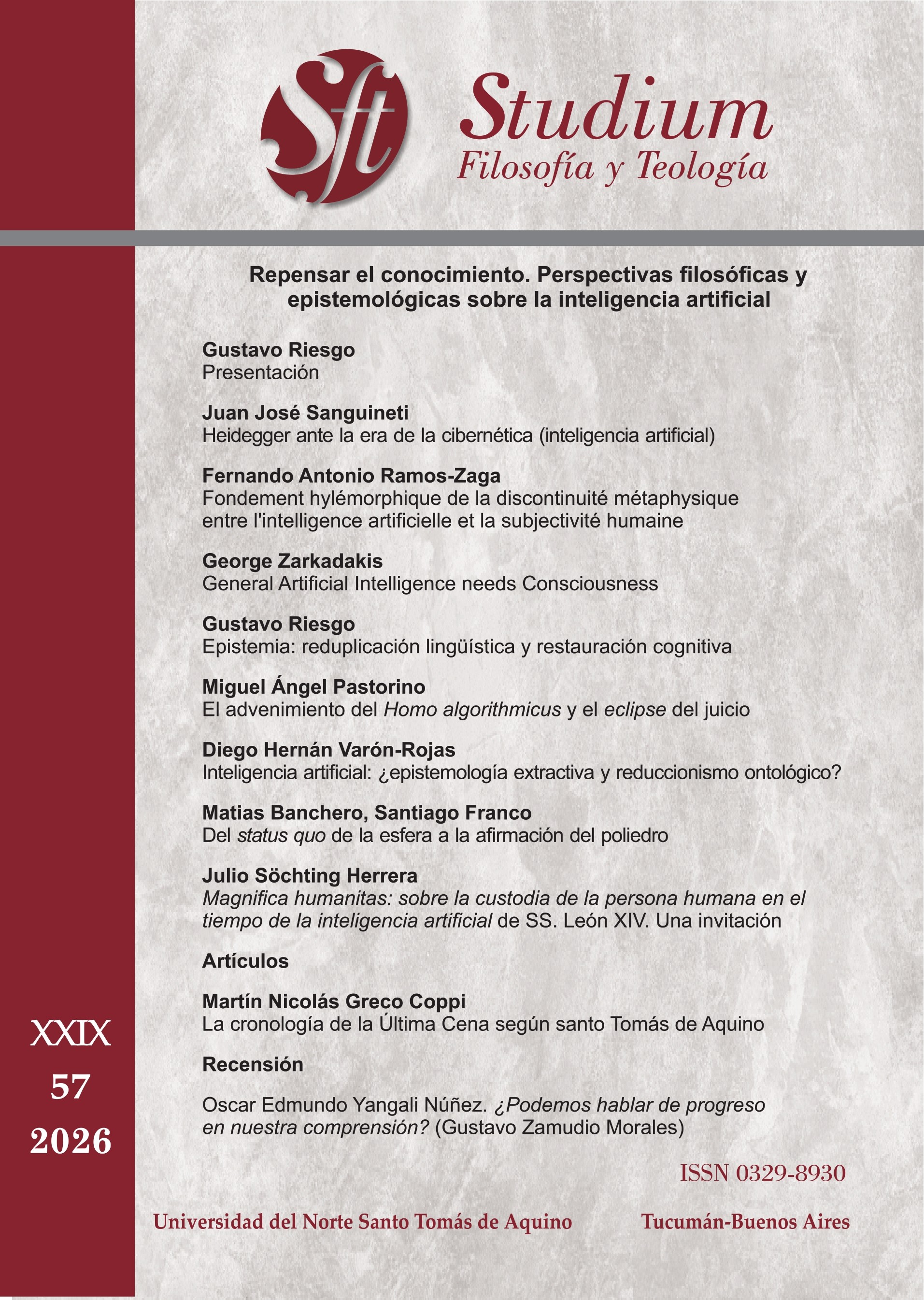
Una Inteligencia Artificial General (AGI) de tipo humano debe explorar la realidad de manera autónoma, establecer sus propios objetivos y demostrar una creatividad genuina, como la realización de descubrimientos científicos originales. La creatividad en los seres humanos está arraigada en la conciencia de alto nivel y en la experiencia subjetiva de la propia identidad personal, lo que la hace inalcanzable para máquinas que son meramente inteligentes pero no conscientes, dado que la creatividad surge de procesos estocásticos que las máquinas solo pueden emular, pero no reproducir. Los problemas del marco y de la detención limitan aún más a los sistemas computacionales convencionales, impidiéndoles trascender sus propios límites operativos. La conciencia, en cambio, puede superar los límites operativos establecidos por la evolución y acceder a niveles más profundos de la realidad. En consecuencia, una AGI sintiente no es posible mediante los enfoques convencionales de la ciencia de la computación. Enfoques alternativos –como la biocomputación o los modelos de la conciencia basados en la mecánica cuántica– podrían dar lugar a máquinas sintientes en el futuro; sin embargo, tales avances hipotéticos plantean profundas cuestiones éticas acerca de la creación de nuevas formas de conciencia.
Descargas
Citas
Balasubramanian, V. (2021). Brain Power. Proc. Natl. Acad. Sci. U. S. A., 118(32), e2107022118. https://doi.org/10.1073/pnas.2107022118
Butlin, P., Long, R., Elmoznino, E., Bengio, Y., Birch, J., Constant, A. et al. (2023). Consciousness in Artificial Intelligence: insights from the Science of Consciousness. arXiv preprint arXiv:2308.08708. https://doi.org/10.48550/arXiv.2308.08708
Chalmers, D. (2007). The Hard Problem of Consciousness. In M. Velmans & S. Schneider (Eds.), The Blackwell Companion to Consciousness (pp. 32-42). Wiley-Blackwell.
Flesch, T., Balaguer, J., Dekker, R., Nili, H. & Summerfield, C. (2018). Comparing Continual Task Learning in Minds and Machines, Proc. Natl. Acad. Sci. U.S.A, 115(44) E10313-E10322. https://doi.org/10.1073/pnas.1800755115
Friston, K. (2010). The Free-energy Principle: A Unified Brain Theory? Nat Rev Neurosci, 11, 127-138. https://doi.org/10.1038/nrn2787
Guo, D., Yang, D., Zhang, H. et al. (2025). DeepSeek-R1 Incentivizes Reasoning in LLMs through Reinforcement Learning. Nature, 645, 633-638. https://doi.org/10.1038/s41586-025-09422-z
Hameroff, S. (2023). Consciousness Is Quantum State Reduction Which Creates the Flow of Time. Timing & Time Perception, 12(2), 158-167. https://doi.org/10.1163/22134468-bja10098
Hoffman, D. (2019). The Case Against Reality: How Evolution Hid the Truth from Our Eyes. Penguin.
Kagan, B. J., Kitchen, A. C., Tran, N. T., Habibollahi, F., Khajehnejad, M., Parker, B. J., Bhat, A., Rollo, B., Razi, A. & Friston, K. J. (2022). In Vitro Neurons Learn and Exhibit Sentience when embodied in a Simulated Game-world. Neuron, 110(23), 3952-3969.e8. http://doi.org/10.1016/j.neuron.2022.09.001
Kung, T. H., Cheatham, M., Medenilla, A., Sillos, C., De Leon, L., Elepaño, C., Madriaga, M., Aggabao, R., Diaz-Candido, G., Maningo, J. & Tseng, V. (2023). Performance of ChatGPT on USMLE: Potential for AI-assisted Medical Education using Large Language Models. PLOS. Digital Health, 2(2), e0000198. http://doi.org/10.1371/journal.pdig.0000198
Kunz, E. M., Krasa B. A., Kamdrar F., et al. (2025). Inner Speech in Motor Cortex and Implications for Speech Neuroprostheses. Cell, 188(17), 4658-4673.e17. https://doi.org/10.1016/j.cell.2025.06.015
Liu, C., Zhuang, K., Zeitlen, D.C. et al. (2024). Neural, Genetic, and Cognitive Signatures of Creativity. Commun Biol, 7, 1324. https://doi.org/10.1038/s42003-024-07007-6
Lu, Ch., Lu, C., Lange, R. T., Foerster, J., Clune, J. & Ha, D. (2024). The AI Scientists: Towards Fully Automated Open-Ended Scientific Discovery. arXiv preprint arXiv:2408.06292. https://doi.org/10.48550/arXiv.2408.06292
Melanson, D., Abu Khater, M., Aifer, M., Donatella, K., Gordon, M. H., Ahle, T., Crooks, G., Martinez, A. J., Sbahi, F. & Coles, P. J. (2025). Thermodynamic Computing System for AI Applications. Nat Commun, 16, 3757. https://doi.org/10.1038/s41467-025-59011-x
McCarthy, J. & Hayes, P. J. (1969). Some Philosophical Problems from the Standpoint of Artificial Intelligence. Machine Intelligence, 4, 463-502.
Owen A. M. (2013). Detecting Consciousness: a Unique Role for Neuroimaging. Annual Review Psychology, 64, 109-133. http://doi.org/10.1146/annurev-psych-113011-143729
Park, P. S., Goldstein, S., O’Gara, A., Chen, M. & Hendrycks, D. (2023). AI Deception: A Survey of Examples, Risks, and Potential Solutions. Patterns, 5(5). https://doi.org/10.1016/j.patter.2024.100988
Park S. H., Kim, K. K. & Hahm, J. (2016). Neuro-Scientific Studies of Creativity. Dement Neurocogn Disord, 15(4), 110-114. https://doi.org/10.12779/dnd.2016.15.4.110
Raduga, M. & Shashkov, A. (2023). Detecting Lucid Dreams by Electroencephalography and Eyebrow Movements. Sleep Science, 16(4), e408-e416. http://doi.org/10.1055/s-0043-1776749
Shumailov, I., Shumaylov, Z., Zhao, Y., Papernot, N., Anderson, R. & Gal, Y. (2024). AI Models Collapse when Trained on Recursively Generated Data. Nature, 631, 755-759. https://doi.org/10.1038/s41586-024-07566-y
The Allen Institute for Artificial Intelligence. (2025, August 26). AstaBench: Rigorous benchmarking of AI agents with a holistic scientific research suite. Ai2. https://allenai.org/blog/astabench
Trinh, T.H., Wu, Y., Le, Q.V., He, H. & Loung, T. (2024). Solving Olympiad Geometry without Human Demonstrations. Nature, 625, 476-482. https://doi.org/10.1038/s41586-023-06747-5
Turing, A. M. (1937). On Computable Numbers, with an Application to the Entscheidungsproblem. Proceedings of the London Mathematical Society. s2-42(1), 230-265. https://doi.org/10.1112/plms/s2-42.1.230
Wiest, M. C. (2025). A Quantum Microtubule Substrate of Consciousness is Experimentally Supported and Solves the Binding and Epiphenomenalism Problems. Neuroscience of Consciousness, 2025(1), niaf011. https://doi.org/10.1093/nc/niaf011
Zarkadakis, G. (2001). Noetics: A Proposal for a Theoretical approach to Consciousness. Proceedings of International Conference “Toward a Science of Consciousness: Consciousness and its place in Nature”. University of Skövde, Sweden, 7-11 August.
Zarkadakis, G. (2015). In Our Own Image: Will Artificial Intelligence Save Us or Destroy Us? Rider Books.













 Esta obra está bajo una