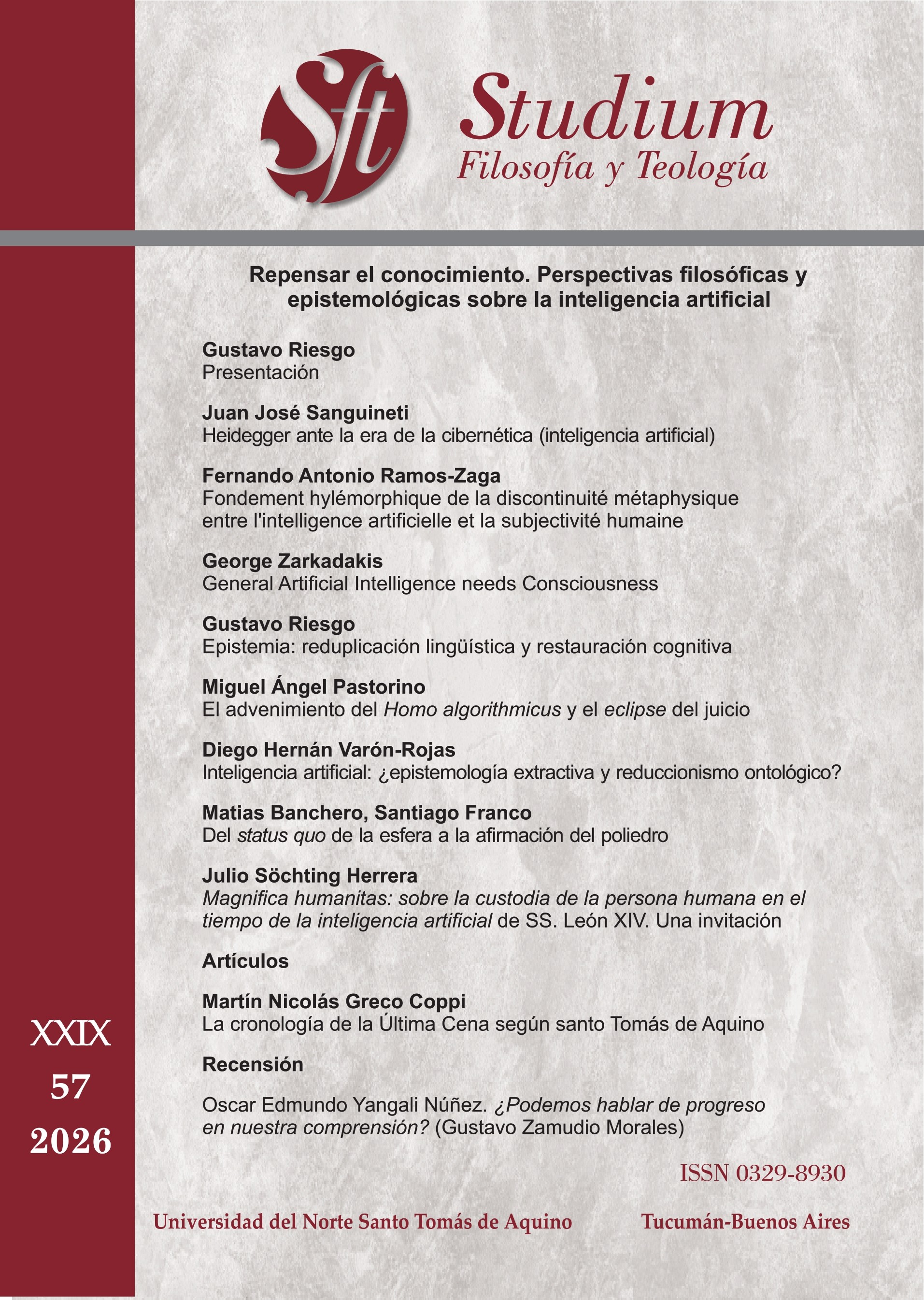
Epistemia: Linguistic Reduplication and Cognitive Restoration
DOI:
https://doi.org/10.53439/stdfyt57.29.2026.89-116Keywords:
epistemia, artificial intelligence, epistemology, cognitive debt, computational simulationAbstract
This article refers to the concept of “epistemia” as a diagnostic category for understanding the epistemological transformations brought about by the use of large language models and generative artificial intelligence. Far from constituting a theory of artificial intelligence or an ontology of cognition, epistemia describes a structural phenomenon emerging from sociotechnical systems: the production of linguistically coherent outputs that lack robust epistemic grounding. This paper argues that this phenomenon results from a deep compatibility between probabilistic text generation and human expectations of meaning, leading to a systematic confusion between plausibility and truth. Furthermore, epistemia is analyzed in relation to cognitive debt and cognitive offloading, highlighting how the externalization of intellectual tasks reshapes habits of judgment, attention, and understanding. A Platonic myth and a Borgesian tale are employed as hermeneutical devices that intensify the perception and analysis of the current phenomenon by offering formal structures that illuminate, by analogy, its ontological and epistemological implications. The analysis situates epistemia within broader debates in philosophy of science and technology, emphasizing its implications for the nature of knowledge, the limits of computational mimesis, and the future of human cognition in AI-mediated environments.
Downloads
References
Akgun, M. & Toker, S. (2024). The Impact of AI on Cognitive Engagement in Higher Education. Journal of Information Science Education, 12(2).
Bender, E., Gebru, T., McMillan-Major, A. & Shmitchell, S. (2021). On the Dangers of Stochastic Parrots: Can Language Models Be Too Big? In Proceedings of the 2021 ACM Conference on Fairness, Accountability, and Transparency (FAccT ’21) (pp. 610–623). Association for Computing Machinery. https://doi.org/10.1145/3442188.3445922
Bjork, R. A. (1994). Memory and Metamemory Considerations in the Training of Human Beings. In J. Metcalfe & A. Shimamura (Eds.). Metacognition: Knowing about knowing (pp. 185–205). MIT Press.
Borges, J. L. (1975). El Libro de Arena. Emecé.
Butler, S. (2025). Erewhon; or, Over the Range (original publicado en 1872). Penguin.
Carr, N. (2010). The Shallows: What the Internet is Doing to Our Brains. W. W. Norton & Company.
Clark, A. & Chalmers, D. (1998). The Extended Mind. Analysis, 58(1), 7-19. https://doi.org/10.1093/analys/58.1.7
Derrida, J. (1968). La pharmacie de Platon. Tel Quel.
Ferrari, G. R. F. (1987). Listening to the Cicadas: A Study of Plato’s Phaedrus. Cambridge University Press.
Floridi, L. (2018). Semantic Capital: Its Nature, Value, and Curation. Philosophy & Technology, 31(4), 481–497. https://doi.org/10.1007/s13347-018-0335-1
Georgiou, G. (2025). ChatGPT Produces More “Lazy” Thinkers: Evidence of Cognitive Engagement Decline. arXiv preprint arXiv:2507.00181. https://doi.org/10.48550/arXiv.2507.00181
Griswold, C. L., Jr. (1986). Self-Knowledge in Plato’s Phaedrus. Yale University Press.
Havelock, E. A. (1963). Preface to Plato. Belknap Press.
Havelock, E. A. (1986). The Muse Learns to Write: Reflections on Orality and Literacy from Antiquity to the Present. Yale University Press.
Hayles, N. K. (2012). How We Think: Digital Media and Contemporary Technogenesis. University of Chicago Press.
Hobsbawm, E. (1964). Labouring Men: Studies in the History of Labour. Weidenfeld & Nicolson.
Hoevel, C. (2021). La industria académica: la universidad bajo el imperio de la tecnocracia global. Teseo.
Hui, Y. (2017). Cosmotechnics as Cosmopolitics. e-flux Journal, (86). https://www.e-flux.com/journal/86/161887/cosmotechnics-as-cosmopolitics
Jose, B., Cherian, J., Verghis, A. M., Varghise, S. M., Mumthas, S. & Sibichan, J. (2025). The Cognitive Paradox of AI in Education: between Enhancement and Erosion. Frontiers in Psychology, 16, 1550621. https://doi.org/10.3389/fpsyg.2025.1550621
Kosmyna, N., Hauptmann, E., Yuan, Y. T., Situ, J., Liao, X.-H., Beresnitzky, A. V., Braunstein, I. & Maes, P. (2025). Your Brain on ChatGPT: Accumulation of Cognitive Debt when Using an AI Assistant for Essay Writing Task. ArXiv preprint arXiv:2506.08872. https://doi.org/10.48550/arXiv.2506.08872
Loru, E., Nudo, J., Di Marco, N., Santirocchi, A., Atzeni, R., Cinelli, M. Cestari, V., Rossi-Arnaud, C. & Quattrociocchi, W. (2025). The Simulation of Judgment in LLMs. arXiv preprint arXiv:2502.04426. https://doi.org/10.48550/arXiv.2502.04426
Marinoff, L. (2000). Más Platón y menos Prozac (B. Folch, trad.). Ediciones B.
Monett, D. (2026). The Critical Use of Degenerative AI in Doctoral Education. 14th EDAMBA-EIASM Consortium on Doctoral Supervision. Esade.
Moretti, F. (2013). Distant Reading. Verso.
Ortega y Gasset, J. (1985). Meditación de la técnica (original publicado en 1939). Alianza Editorial.
Pacioli, L. (1994). De las cuentas y las escrituras (original publicado en 1494). AECA.
Platón, (1992). Fedro (C. García Gual, trad.). Gredos.
Quattrociocchi, W., Capraro, V. & Perc, M. (2025). Epistemological Fault Lines Between Human and Artificial Intelligence. arXiv preprint arXiv:2512.19466. https://doi.org/10.48550/arXiv.2512.19466
Riesgo, G. (2023). Entender o calcular: aspectos cognitivos del aprendizaje de máquina y el lenguaje natural [Tesis de Maestría, Universidad Austral].
Riesgo, G. (2024). ¿Qué es la Filosofía de la IA? PhilofAI. https://philofai.org
Riesgo, G. (2025a). Hipálage. El Efecto ELIZA desde la perspectiva de la atribución mental y el desplazamiento epistémico de la inteligencia personal. En P. E. García (Ed.), La persona entre lo individual y lo comunitario. Pontificia Universidad de Salamanca.
Riesgo, G. (2025b). No sos vos, somos nos: Sobre la necesidad de modificar la narrativa de la inteligencia artificial al plural. En Alfabetización e inteligencia artificial. Universidad Austral.
Riesgo, G. (2026). Aipoiesis: Transposición y mímesis entre narrativas de la ciencia ficción y el realismo en inteligencia artificial. Cuadernos de la UCA. Filosofía y Letras.
Sadin, E. (2023). La vie spectrale : Penser l’ère du métavers et des IA génératives. Grasset.
Sanguineti, J. J. (2005). El conocimiento humano: una perspectiva filosófica. Ediciones Palabra.
Shirky, C. (27 de agosto de 2025). Hay una crisis de estudiantes haciendo trampa con la IA. Las universidades deben cambiar [Opinión]. The New York Times (en español). https://www.nytimes.com/es/2025/08/27/espanol/opinion/chatgpt-ia-trampa-universidades.html
Simondon, G. (2005). L’individuation à la lumière des notions de forme et d’information. Jérôme Millon.
Simondon, G. (2012). Du mode d’existence des objets techniques. Aubier.
Vallor, S. (2024). The AI Mirror: How to Reclaim Our Humanity in an Age of Machine Thinking. Oxford University Press.
Weidlich, J., Gašević, D., Drachsler, H. & Kirschner, P. (2025). ChatGPT in Education: An Effect in Search of a Cause. Journal of Computer Assisted Learning, 41(5), e70105. https://doi.org/10.1111/jcal.70105
Wolf, M. (2018). Reader, Come Home: The Reading Brain in a Digital World. Harper.
World Economic Forum. (2025, 7 January). Future of Jobs Report 2025. https://www.weforum.org/publications/the-future-of-jobs-report-2025/
Yan, L., Greiff, S., Lodge, J. M. et al. (2025). Distinguishing Performance Gains from Learning when Using Generative AI. Nature Reviews Psychology, 4, 435-436. https://doi.org/10.1038/s44159-025-00467-5