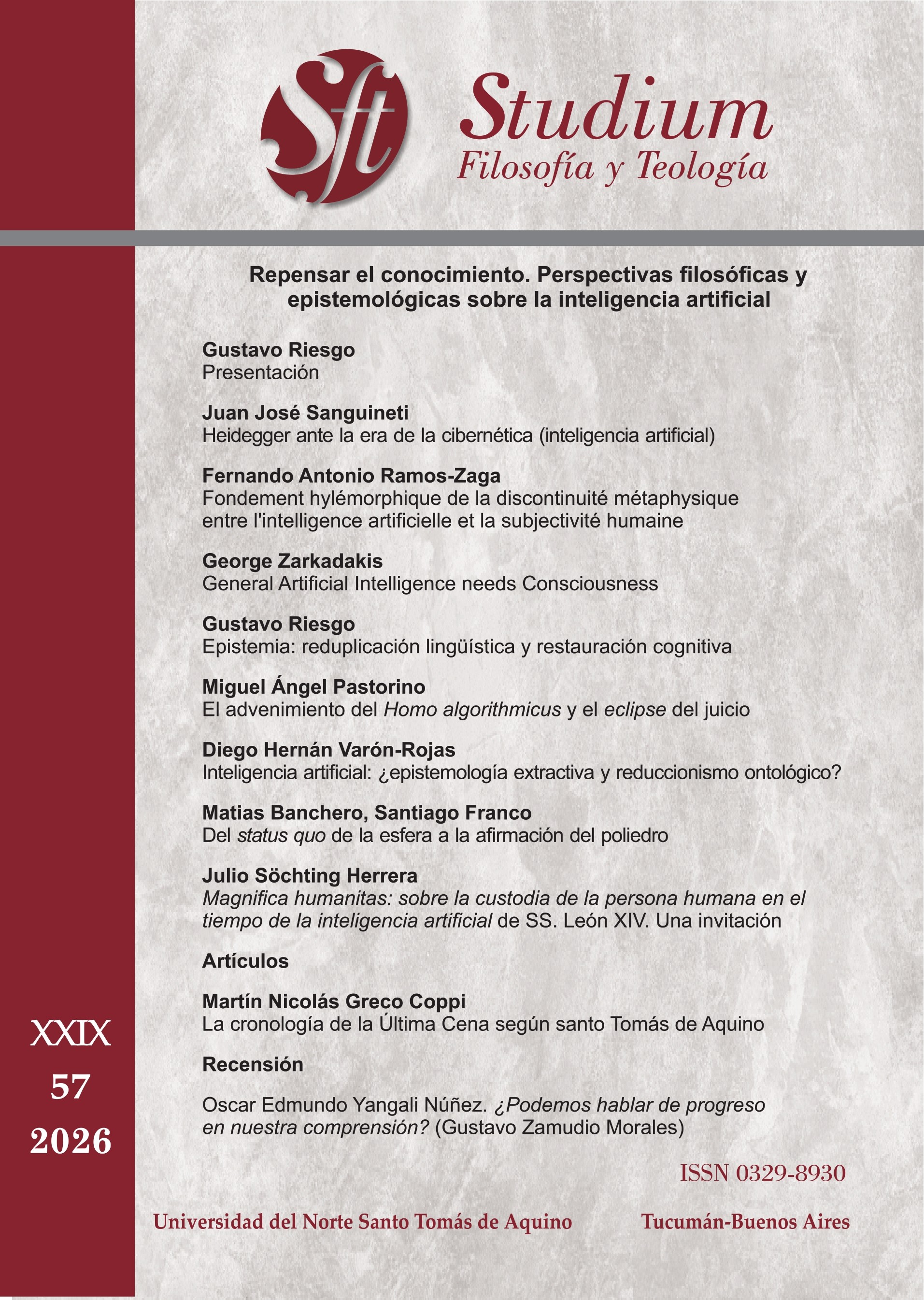
The Advent of Homo Algorithmicus and the Eclipse of Judgment
Technology, Nihilism, and Democratic Crisis
DOI:
https://doi.org/10.53439/stdfyt57.29.2026.117-138Keywords:
algorithms, artificial intelligence, technological humanism, philosophy of technology, technocracy, nihilismAbstract
This article examines the anthropological, political, and ethical transformation brought about by the expansion of artificial intelligence (AI) in the twenty-first century, understood not as a mere technical advance but as a civilizational event that reconfigures social rationality, forms of power, and the conditions of possibility of democracy. Drawing on a philosophical analysis in dialogue with contemporary authors, the article argues that the core of the challenge lies not in the intelligence of algorithms, but in the progressive externalization of human judgment and decision-making into automated systems. On the anthropological level, the emergence of Homo algorithmicus expresses a mutation of subjectivity characterized by the delegation of judgment to recommendation architectures that impoverish experience and erode autonomy. On the political level, algorithmic rationality reorganizes the public sphere through forms of automated governance that privilege efficiency and prediction, displacing deliberation, weakening accountability, and conflating technical correctness with democratic legitimacy. On the ethical level, the article maintains that the challenges posed by AI cannot be addressed exclusively through normative codes, but require a political critique of algorithmic reason capable of subjecting technology to the horizon of self-government, the common good, and democratic responsibility. The article concludes that the contemporary challenge does not consist in perfecting algorithms, but in preserving and strengthening the human capacity to decide, deliberate, and assume the uncertainty inherent in democratic life within an increasingly automated world.
Downloads
References
Arendt, H. (2010). La vida del espíritu. Paidós.
Arendt, H. (2015). La condición humana (M. Sacristán, trad., 6a. ed.). Paidós.
Bertolaso, M. y Marcos, A. (2023). Umanesimo tecnologico. Una riflessione filosofica sull’intelligenza artificale. Carocci Editore.
Carr, N. (2014). Atrapados. Cómo las máquinas se apoderan de nuestras vidas. Taurus.
Coeckelbergh, M. (2021). Ética de la inteligencia artificial. Cátedra.
Coeckelbergh, M. (2023). Filosofía política de la inteligencia artificial: Una introducción. Cátedra.
Coeckelbergh, M. (2024). Por qué la IA debilita la democracia y qué hacer al respecto. Cátedra.
Cortina, A. (2024). ¿Ética o ideología de la inteligencia artificial? Paidós.
Costa Rugnitz, N. (2025). Tecno-productividad: Notas sobre lo digital en el horizonte de la Inteligencia Artificial Generativa. Taurus.
Crawford, K. (2023). Atlas de inteligencia artificial: Poder, política y costos planetarios (F. Díaz Klaassen, trad.). Taurus.
Daston, L. & Galison, P. (2010). Objectivity. Princeton University Press.
Gómez Pin, V. (2025). El ser que cuenta: La disputa por la singularidad humana. Acantilado.
Han, B.-Ch. (2021). No-cosas: quiebras del mundo de hoy. Penguin Random House.
Han, B.-Ch. (2022). Infocracia: La digitalización y la crisis de la democracia. Taurus.
Heidegger, M. (2006). La pregunta por la técnica. En Conferencias y artículos (E. Barjau, trad.). Serbal.
Innerarity, D. (2025). Una teoría crítica de la inteligencia artificial. Galaxia Gutemberg.
Lasalle, J. M. (2019). Cyberleviatán: El colapso de la democracia liberal frente a la revolución digital. Arpa.
Lasalle, J. M. (2024). Civilización artificial. Arpa.
Mazza, J. (2025). Somos tecnología: Exploración filosófica del paisaje humano-técnico. Taurus.
Ortega y Gasset, J. (2014). Ensimismamiento y alteración. Meditación de la técnica y otros ensayos. Alianza.
Pastorino, M. (2025). Pensar en la era de las máquinas: ¿Por qué la filosofía es inevitable? Taurus.
Sadin, E. (2020). La inteligencia artificial o el desafío del siglo. Anatomía de un antihumanismo radical. Caja Negra.
Sadin, E. (2022). La era del individuo tirano. El fin del mundo común. Caja Negra.
Sadin, E. (2024). La vida espectral. Pensar la era del metaverso y las inteligencias artificiales generativas. Caja Negra.
Savulescu, J. y Lara, F. (2021). Más que humanos. Biotecnología, inteligencia artificial y ética de la mejora. Tecnos.
Sigman, M. y Bilinkis, S. (2023). Artificial. La nueva inteligencia y el contorno de lo humano. Penguin Random House.
Simondon, G. (2008). El modo de existencia de los objetivos técnicos. Prometeo.
Vallor, S. (2024). The AI Mirror: How to Reclaim our Humanity in an Age of Machine Thinking. Oxford University Press.
Varela, L. (2022). Espejos: filosofía y nuevas tecnologías. Herder.
Zubiri, X. (2007). Sobre el hombre. Alianza.
Zubiri, X. (2011). Inteligencia Sentiente. Vol. 1: inteligencia y realidad. Alianza.