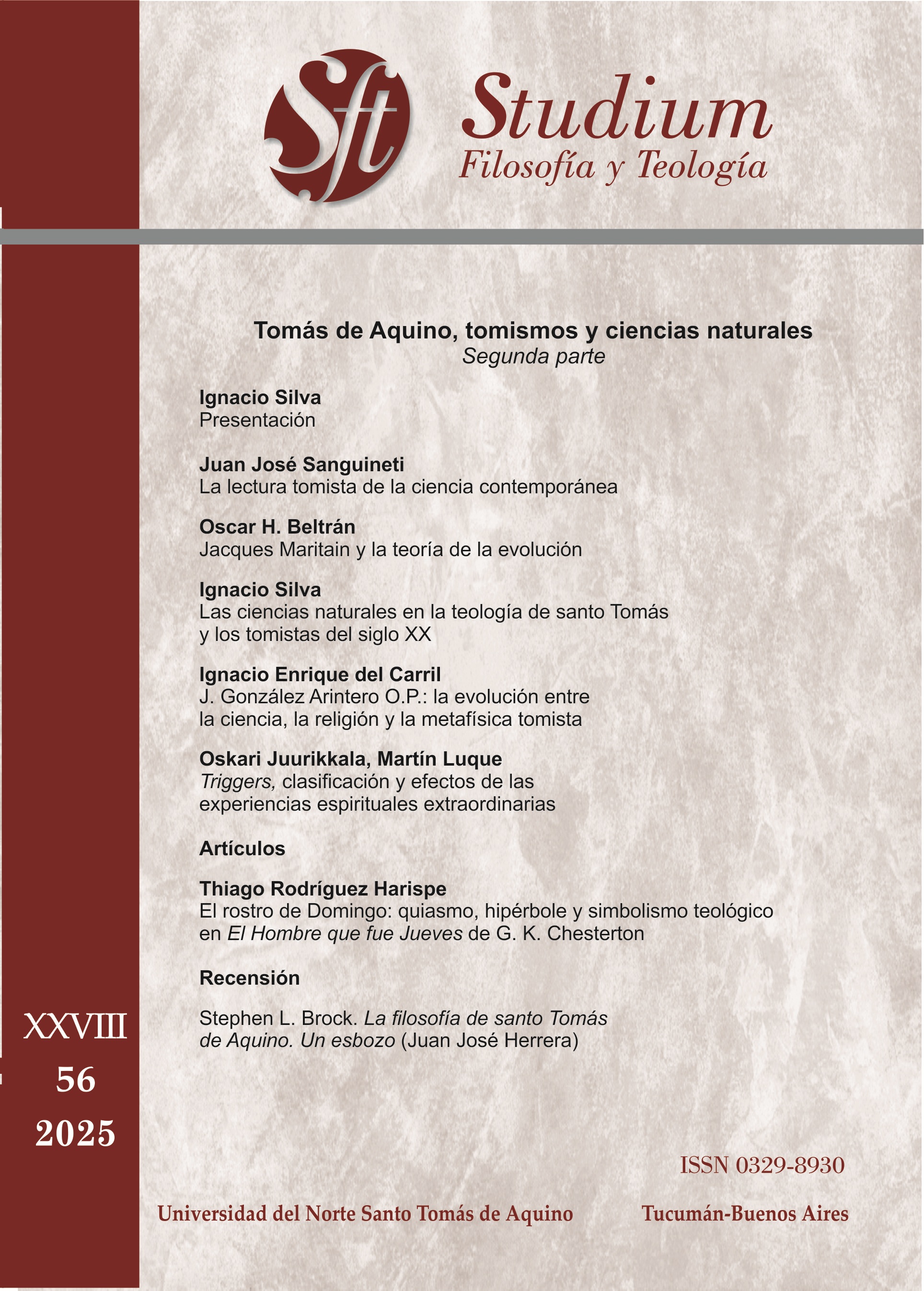
Triggers, classification and effects of extraordinary spiritual experiences
A Thomistic view of neurotheology
DOI:
https://doi.org/10.53439/stdfyt56.28.2025.333-358Keywords:
spiritual experience, neurotheology, Thomas Aquinas, hylomorphism, nature and grace, virtues, capax DeiAbstract
This article establishes a dialogue between the work of David Yaden and Andrew Newberg in The Varieties of Spiritual Experience (2023) and the philosophical-theological framework of Thomas Aquinas. Drawing on three key categories from the book –the triggers of spiritual experiences, their classification into six types (numinous, revelatory, synchronic, mystical, aesthetic, and paranormal), and their transformative outcomes– we employ Thomistic concepts such as hylomorphism, the person as capax Dei, the nature-grace relationship, extraordinary spiritual gifts, and the role of the will in the acquisition of virtues, to show how the Thomistic approach brings light to contemporary research on spiritual experience and is open to learning from new data.
Downloads
References
Algoe, S. B. & Haidt, J. (2009). Witnessing Excellence in Action: The “Other-Praising” Emotions of Elevation, Gratitude, and Admiration. Journal of Positive Psychology, 4(2), 105-127. https://doi.org/10.1080/17439760802650519
Appelle, S. (1996). The Abduction Experience: A Critical Evaluation of Theory and Evidence. Journal of UFO Studies, 6, 29-78.
Ashbrook, J. B. (1997). The Humanizing Brain: Where Religion and Neuroscience Meet. Pilgrim Press.
Aumann, J. (2019). Spiritual Theology. Bloomsbury.
Barrett, F. S., Johnson, M. W. & Griffiths, R. (2015). Validation of the Revised Mystical Experience Questionnaire in Experimental Sessions with Psilocybin. Journal of Psychopharmacology, 29(11), 1182-1190. https://doi.org/10.1177/0269881115609019
Beauregard, M. & O’Leary, D. (2008). The Spiritual Brain, a Neuroscientist’s Case for the Existence of the Soul. HarperOne.
Chalmers, D. J. (1995). Facing Up to the Problem of Consciousness (Vol. 2, pp. 207-228). Routledge. https://doi.org/10.4324/9780203826430-11
De Haan, D. (2017a). Hylomorphism and the New Mechanist Philosophy in Biology, Neuroscience and Psychology. In W. Simpson, R. Koons & N. Teh (Eds.), Neo-Aristotelian Perspectives on Contemporary Science (pp. 293-326). Routledge. https://doi.org/10.4324/9781315211626
De Haan, D. (2017b). Hylomorphic Animalism, Emergentism, and the Challenge of the New Mechanist Philosophy of Neuroscience. Scientia et Fides, 5(2), 9-38. https://hdl.handle.net/10171/44007
Fuchs, T. (2017). Ecology of the Brain: The Phenomenology and Biology of the Embodied Mind. Oxford University Press. https://doi.org/10.1093/med/9780199646883.001.0001
Garrigou-Lagrange, R. (1948). The Three Ages of the Interior Life (vol. 2). Herder.
Griffiths, R. R., Richards, W. A., Johnson, M. W., McCann, U. & Jesse, R. (2018). Mystical-type Experiences occasioned by Psilocybin Mediate the Attribution of Personal Meaning and Spiritual Significance 14 Months Later. Journal of Psychopharmacology, 22(6), 621-632. https://doi.org/10.1177/0269881108094300
Grof, S. & Grof, C. (1989). Spiritual Emergency: When Personal Transformation Becomes a Crisis. Tarcher.
Hadlaczky, G. & Westerlund, J. (2011). Sensitivity to Coincidences and Paranormal Belief. Perceptual and Motor Skills, 113(3), 894-908. https://doi.org/10.2466/09.22.PMS.113.6.894-908
Hagerty, B. B. (2009). Fingerprints of God: The Search for the Science of Spirituality. Penguin.
Horvat, S. (2017). Neuroscientific findings in the Light of Aquinas’ understanding of the Human Being. Scientia et Fides, 5(2), 127-153. https://hdl.handle.net/10171/44012
Irwin, H. J. & Watt, C. A. (2007). An Introduction to Parapsychology. McFarland.
James, W. (2012). The Varieties of Religious Experience: A Study in Human Nature. Oxford University Press (original publicado en 1902).
Jordan B. Peterson. (2021, May 10). The Psychology of Psychedelics [Video file]. https://youtu.be/NGIP-3Q-p_s?si=WfU_2bFr8STSCanv
Jones, J. M. (2023, September 22). In U.S., 47% Identify as Religious, 33% as Spiritual. Gallup News. https://news.gallup.com/poll/511133/identify-religious-spiritual.aspx
Kass, J. D., Friedman, R., Leserman, J., Zuttermeister, P. C. & Benson, H. (1991). Index of Core Spiritual Experiences (INSPIRIT) [Database record]. APA PsycTests. https://doi.org/10.1037/t01039-000
Koenig, H., Peteet, J. & VanderWeele, T. J. (2020). Religion and Psychiatry: Clinical Applications. BJPsych Advances, 26(5), 273-281. https://doi.org/10.1192/bja.2020.11
Kornfield, Jack. (2001). After the Ecstasy, the Laundry. Bantam.
Latourelle, R. (1966). Theology of Revelation. Alba House.
Lombo, J. Á. y Giménez Amaya, J. (2013). La unidad de la persona. Aproximación desde la filosofía y la neurociencia. EUNSA.
Lombo, J. Á. y Giménez Amaya, J. (2016). Biología y racionalidad. El carácter distintivo del cuerpo humano. EUNSA.
Luhrmann, T. M. (2012). When God Talks Back: Understanding the American Evangelical Relationship with God. Knopf.
Medrano, J. (2014). DSM-5, un año después. Revista de la Asociación Española de Neuropsiquiatría, 34(124), 655-662. https://dx.doi.org/10.4321/S0211-57352014000400001
Millet, W. R. & C’de Baca, J. (2001). Quantum Changes: When Epiphanies and Sudden Insights Transform Ordinary Lives. Guilford Press.
Morrison, S. C. & Cohen, A. S. (2014). The Moderating Effects of Perceived Intentionality: Exploring the Relationships between Ideas of Reference, Paranoia and Social Anxiety in Schizotypy. Cognitive Neuropsychiatry, 19(6), 527–539. https://doi.org/10.1080/13546805.2014.931839
Newberg, A. (2010). Principles of Neurotheology. Ashgate.
Newberg, A. & Waldman, M. R. (2016). How Enlightenment Changes Your Brain: The New Science of Transformation. Penguin Random House.
Pargament, K., Lomax, J., Mcgee, J. S. & Fang, Q. (2014). Sacred Moments in Psychotherapy from the Perspectives of Mental Health Providers and Patients. Spirituality in Clinical Practice, 1(4), 248–262. https://doi.org/10.1037/scp0000043
Park, C. (2010). Making Sense of the Meaning Literature: An Integrative Review of Meaning Making and its Effects on Adjustment to Stressful Life Events. Psychological Bulletin, 136(2), 257-301. https://doi.org/10.1037/a0018301
Paul, L. A. (2014). Transformative Experience. Oxford University Press. https://doi.org/10.1093/acprof:oso/9780198717959.001.0001
Peteet, J. R. & Narrow, W. E. (2011). Religious and Spiritual Issues in Psychiatric Diagnosis: A Research Agenda for DSM-V. American Psychiatric Association Publishing.
Pinsent, A. (2015). Neurotheology. In J. Clausen & N. Levy (Eds.), Handbook of Neuroethics (pp. 1527-1533). Springer. https://doi.org/10.1007/978-94-007-4707-4_95
Putnam, R. (2008). The Cambridge Companion to William James. Cambridge University Press. https://doi.org/10.1017/CCOL0521452783
Ramachandran, V. S. (2012). The Tell-Tale Brain, A Neuroscientist’s Quest for What Makes Us Human. W.W. Norton.
Rogers, P. M. (2023). Aquinas on Prophecy: Wisdom and Charism in the Summa Theologiae. Catholic University of American Press. https://doi.org/10.2307/jj.4145197
Seligman, M. (2004). Authentic Happiness: Using the New Positive Psychology to Realize Your Potential for Lasting Fulfillment. Simon & Schuster.
Simeon, D. (2004). Depersonalization Disorder: a Contemporary Overview. CNS Drugs, 18(6), 343-354. https://doi.org/10.2165/00023210-200418060-00002
Sullivan, K. D. (1991). An Astronaut’s View of Earth. Update. Newsletter of the National Geographic Society’s Geography Education Program, 1, 12-14.
Vörös, S. (2014). Neurotheologia, Quo Vadis: Some Philosophical Problems of Neurotheology. Prolegomena, 13(2), 351-372. https://hrcak.srce.hr/file/191539
White, F. (1998). The Overview Effect: Space Exploration and Human Evolution. American Institute of Aeronautics and Astronautics.
Widiger, T. A. (Ed.). (2017). The Oxford Handbook of the Five Factor Model. Oxford University Press. https://doi.org/10.1093/oxfordhb/9780199352487.001.0001
Yaden, D. B. & Ferguson, M. (2022). The Varieties of Spiritual Experience. 21st Century Research, and Perspectives. A conversation with David Yaden and Michael Ferguson. Harvard Divinity School Podcast. https://cswr.hds.harvard.edu/news/video-varieties-spiritual-experience-21st-century-research-and-perspectives
Yaden D. B., Iwry, J. & Newberg, A. B. (2016). Neuroscience and Religion: Surveying the Field. In N. K. Clements (Ed.). Religion: Mental Religion (pp. 277-299.). Macmillan.
Yaden, D. B., Kaufman, S. B., Hyde, E., Chirico, A., Gaggioli, A., Zhang, J. W., & Keltner, D. (2019). The development of the Awe Experience Scale (AWE-S): A multifactorial measure for a complex emotion. The Journal of Positive Psychology, 14(4), 474-488. https://doi.org/10.1080/17439760.2018.1484940
Yaden, D. B., McCall, T. D. & Ellens, H. (Eds.) (2015). Being Called: Scientific, Secular, and Sacred Perspectives. ABC-CLIO.
Yaden, D. B. & Newberg, A. (2023). The Varieties of Spiritual Experience: 21st Century Research and Perspectives. Oxford University Press. https://doi.org/10.1093/oso/9780190665678.001.0001
Zollschan, G. K., Chumaker, J. & Walsh, G. (1995). Exploring the Paranormal: Perspectives on Belief and Experience. Prism Press.